In today’s digital world, AI content creation tools are transforming how businesses, bloggers, marketers, and creators produce content. What once took hours of brainstorming, writing, editing, and optimization can now be accomplished in a fraction of the time without sacrificing quality.
Whether you’re a blogger aiming to rank higher on Google, a marketer managing multiple campaigns, or a business owner trying to scale content production, AI-powered tools have become an essential part of modern content strategies.
This comprehensive guide explores everything you need to know about AI content creation tools, including how they work, their benefits, limitations, best use cases, SEO advantages, and how to choose the right tool for your needs.
Table of Contents
What Are AI Content Creation Tools?
AI content creation tools are software applications powered by artificial intelligence that assist users in generating, editing, optimizing, and repurposing content.
These tools use advanced technologies such as:
- Natural Language Processing (NLP)
- Machine Learning (ML)
- Generative AI
- Large Language Models (LLMs)
They can help create:
- Blog posts
- Articles
- Social media content
- Email campaigns
- Product descriptions
- Ad copy
- Video scripts
- Landing pages
- SEO content
- Content briefs
Instead of starting from a blank page, users can generate ideas, outlines, drafts, and polished content within minutes.
Why AI Content Creation Tools Matter More Than Ever
Content demand is growing across all digital channels, making AI tools for business an essential investment for companies looking to streamline content creation and marketing operations.
Benefits of AI Content Creation Tools
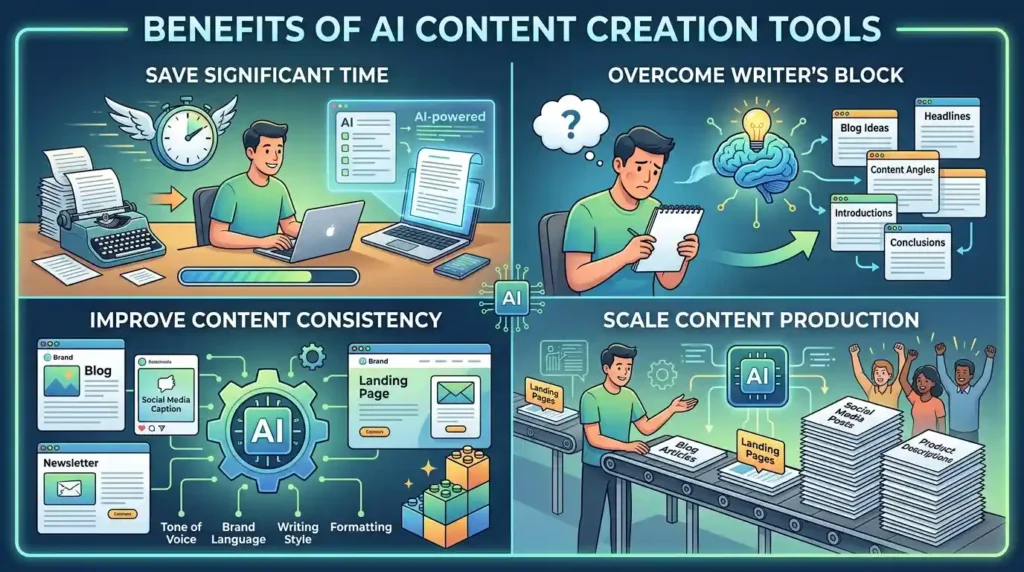
Save Significant Time
One of the biggest advantages is speed.
Instead of spending hours creating outlines and first drafts, AI can generate them almost instantly.
This allows creators to focus on:
- Research
- Fact-checking
- Editing
- Strategy
Overcome Writer’s Block
Every writer faces creative roadblocks.
AI tools can generate:
- Blog ideas
- Headlines
- Content angles
- Introductions
- Conclusions
This keeps the creative process moving.
Improve Content Consistency
Brands need consistent messaging.
AI helps maintain:
- Tone of voice
- Brand language
- Writing style
- Formatting
Across multiple content channels.
Scale Content Production
Businesses can produce more:
- Blog articles
- Landing pages
- Social media posts
- Product descriptions
Without overwhelming their teams.
How We Selected the Best AI Content Creation Tools
The tools below were evaluated based on:
- Ease of use
- Content quality
- AI capabilities
- SEO features
- Automation options
- Pricing value
- Popularity among marketers
- Long-term reliability
25 Best AI Content Creation Tools
1. Jasper AI
Best For: Marketing Copy
Jasper is designed specifically for marketers who need high-converting content.
Key Features
- Brand voice training
- Campaign creation
- Blog writing
- Ad copy generation
Why It’s Popular
Jasper excels at creating persuasive marketing content at scale.
2. Claude
Best For: Long-Form Writing
Claude is known for generating detailed, coherent, and context-rich content.
Strengths
- Long context windows
- Natural writing style
- Excellent summarization
Perfect For
- Guides
- Whitepapers
- Research articles
- Documentation
3. ChatGPT
Best For: General Content Creation
ChatGPT remains one of the most versatile AI content creation tools available.
It can generate:
- Blog posts
- Email copy
- Social media content
- Product descriptions
- Scripts
- Content outlines
Pros
- Highly flexible
- Excellent conversational writing
- Strong research assistance
- Supports multiple industries
Ideal For
Bloggers, marketers, freelancers, and businesses.
4. Copy.ai
Best For: Sales and Marketing Teams
Copy.ai automates repetitive content workflows.
Features
- Marketing campaigns
- Sales outreach
- Content automation
- Workflow creation
Businesses use it to scale content operations efficiently.
5. Writesonic
Best For: SEO Blog Writing
Writesonic combines AI writing with SEO-focused features.
Benefits
- Blog generation
- Landing pages
- Product descriptions
- AI chatbot functionality
A strong option for content marketers.
6. Surfer SEO
Best For: SEO Optimization
Creating content is only half the battle.
Surfer SEO helps ensure your content ranks.
Key Features
- Content scoring
- SERP analysis
- Keyword optimization
- Competitor insights
7. Frase
Best For: Content Research
Frase streamlines research and content planning.
Advantages
- AI-generated briefs
- SERP analysis
- Question research
- SEO optimization
Ideal for publishing authority content.
8. Grammarly
Best For: Editing and Proofreading
Even excellent AI-generated content needs polishing.
Features
- Grammar correction
- Tone suggestions
- Clarity improvements
- Style recommendations
A must-have tool for professional content.
9. QuillBot
Best For: Paraphrasing
QuillBot helps rewrite content while preserving meaning.
Common Uses
- Rephrasing
- Simplification
- Academic writing
- Content enhancement
10. Notion AI
Best For: Productivity and Content Planning
Notion AI combines workspace management with AI assistance.
Useful For
- Content calendars
- Team collaboration
- Brainstorming
- Documentation
11. Canva AI
Best For: Graphic Design
Visual content is critical for engagement.
Canva AI helps create:
- Social graphics
- Presentations
- Marketing materials
- Infographics
No advanced design skills required.
12. Midjourney
Best For: AI Image Generation
Midjourney creates stunning visual artwork from text prompts.
Best Uses
- Blog graphics
- Marketing visuals
- Creative projects
- Branding concepts
13. Adobe Firefly
Best For: Commercial AI Design
Adobe Firefly integrates AI directly into professional design workflows.
Advantages
- Commercial-friendly images
- Adobe ecosystem integration
- Advanced editing
14. DALL·E
Best For: Creative Visuals
DALL·E generates realistic and artistic images from simple prompts.
Perfect for creators needing custom visuals quickly.
15. Synthesia
Best For: AI Video Creation
Video marketing continues to dominate digital content.
Synthesia allows users to create videos without cameras or actors.
Features
- AI avatars
- Voiceovers
- Training videos
- Marketing content
16. Pictory
Best For: Turning Articles Into Videos
Pictory converts blog posts into engaging videos.
Why Content Marketers Love It
One article can become multiple video assets.
17. Descript
Best For: Podcast Editing
Descript simplifies audio and video editing.
Key Benefits
- Text-based editing
- AI voice cloning
- Automatic transcription
Perfect for creators and podcasters.
18. Murf AI
Best For: AI Voiceovers
Murf generates realistic human-like voices.
Common Applications
- Explainer videos
- E-learning
- Podcasts
- Advertisements
19. ElevenLabs
Best For: Advanced Voice Generation
ElevenLabs offers some of the most natural AI voices available today.
Strengths
- Emotional voice delivery
- Multiple languages
- Realistic narration
20. VidIQ
Best For: YouTube Growth
VidIQ helps creators optimize videos for better reach.
Features
- Keyword research
- Trend discovery
- Channel analytics
- Content ideas
21. TubeBuddy
Best For: YouTube SEO
TubeBuddy simplifies video optimization.
Benefits
- SEO recommendations
- A/B testing
- Thumbnail testing
- Performance tracking
22. MarketMuse
Best For: Content Strategy
MarketMuse uses AI to identify content gaps and opportunities.
Great For
- Topic clusters
- Authority building
- Content planning
23. Hemingway Editor
Best For: Readability
Complex writing often loses readers.
Hemingway improves:
- Clarity
- Simplicity
- Readability
- User engagement
24. Rytr
Best For: Budget-Friendly AI Writing
Rytr provides affordable AI writing assistance.
Features
- Multiple templates
- Fast content generation
- Beginner-friendly interface
A great choice for small businesses.
25. ContentShake AI
Best For: SEO Content Marketing
ContentShake AI helps generate content ideas and SEO-focused articles.
Key Benefits
- Keyword suggestions
- Topic research
- Content optimization
Perfect for growing organic traffic.
AI Content Creation Tools Comparison Table
| Tool | Best For | Category |
| ChatGPT | General Content | Writing |
| Jasper | Marketing Copy | Writing |
| Claude | Long Articles | Writing |
| Surfer SEO | SEO Optimization | SEO |
| Frase | Content Research | SEO |
| Grammarly | Editing | Editing |
| Canva AI | Design | Graphics |
| Midjourney | Images | Visuals |
| Synthesia | Videos | Video |
| ElevenLabs | Voiceovers | Audio |
Best AI Tools by Use Case
Not every creator needs all 25 tools.
Instead, choose based on your goals.
For Bloggers
Recommended stack:
- ChatGPT
- Surfer SEO
- Grammarly
- Canva AI
For YouTubers
Recommended stack:
- VidIQ
- TubeBuddy
- Descript
- ElevenLabs
For Agencies
Recommended stack:
- Jasper
- Claude
- Surfer SEO
- MarketMuse
For Small Businesses
Recommended stack:
- Rytr
- Canva AI
- Grammarly
- ChatGPT
AI Content Creation Tools and SEO

SEO remains one of the biggest reasons businesses adopt AI tools.
However, simply generating content is not enough.
Google rewards:
- Helpful content
- Accurate information
- User-focused writing
- Expertise
- Trustworthiness
The best results come from combining AI efficiency with human creativity and expertise.
How AI Supports SEO
Keyword Research
AI identifies relevant keywords and semantic variations.
Search Intent Matching
It helps align content with user expectations.
Content Optimization
AI can suggest:
- Heading structures
- Keyword placement
- Internal linking opportunities
Content Refreshing
Existing content can be updated faster using AI assistance.
Common Mistakes When Using AI Content Creation Tools
Many website owners fail because they rely too heavily on automation.
Avoid these mistakes.
Publishing Without Editing
As recommended by Google Search Central, content creators should always review, fact-check, and improve AI-generated content before publishing. If you’re just getting started with AI, see our list of best free AI tools without sign up — perfect for beginners testing AI for the first time.
Human editing improves:
- Accuracy
- Clarity
- Trustworthiness
How to Choose the Right AI Content Creation Tool
Not all AI tools are equal.
Consider these factors.
Ease of Use
A user-friendly interface improves productivity.
Content Quality
Evaluate:
- Readability
- Accuracy
- Creativity
- Natural language output
SEO Features
Look for:
- Keyword recommendations
- Content optimization
- SERP analysis
Integrations
The best tools connect with:
- CMS platforms
- SEO software
- Marketing tools
Pricing
Choose a tool that matches your:
Budget
Your budget decides which tool you can use. Some tools offer free plans, while others require paid subscriptions. Always choose a tool that fits your needs, not just the cheapest option.
Team Size
If you are a solo creator, simple tools are enough. For teams or agencies, choose tools that support collaboration and workflows.
Content Goals
Choose tools based on what you want to create — blogs, SEO content, social media posts, videos, or marketing copy.
Future Trends in AI Content Creation
The AI landscape continues evolving rapidly.
Several trends are shaping the future.
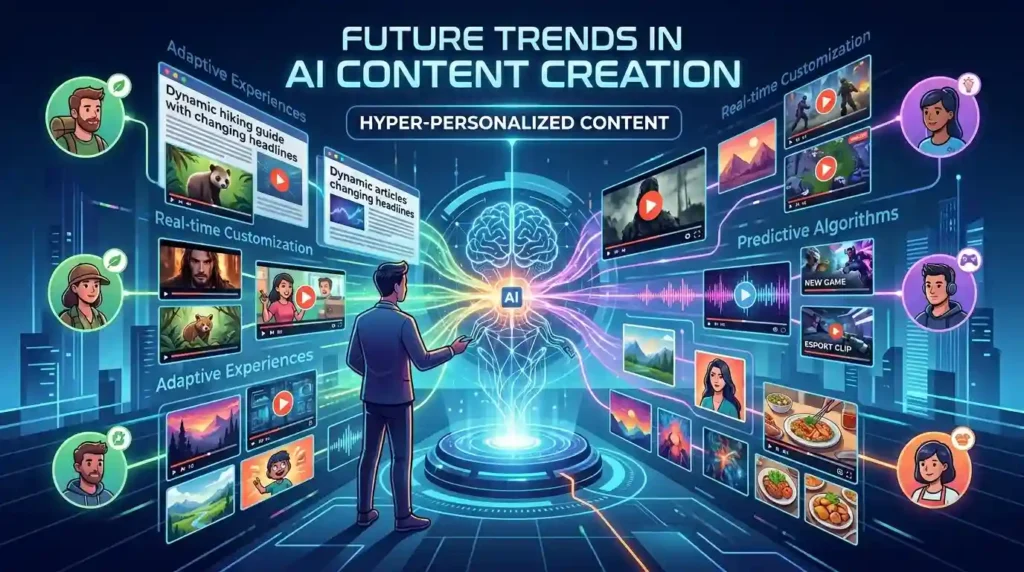
Hyper-Personalized Content
AI will create increasingly customized experiences based on user behavior.
As technology evolves, more AI tools and digital tools will combine content creation, automation, analytics, and marketing into unified platforms.
Multimodal Content Creation
Future tools will combine:
- Text
- Images
- Audio
- Video
Organizations such as Google AI are actively developing multimodal systems that combine multiple content formats into a single workflow.
AI-Powered Content Strategy
AI will assist not only with writing but also with planning and performance analysis.
Search Evolution (AI Overviews, Conversational Search, GEO Optimization)
Search is changing from keyword-based results to AI-driven answers.
AI Overviews
Google now shows AI-generated summaries directly in search results. Users often get answers without clicking websites, so content must be clear and well-structured.
Conversational Search
People now search using full questions instead of keywords (e.g., “best AI tool for blogging”). Content should answer questions naturally and directly.
GEO Optimization (Generative Engine Optimization)
Content is now optimized not only for Google but also for AI systems like ChatGPT-style search and AI-powered search engines. It focuses on:
- Clear explanations
- Structured headings
- Direct answers
- Trustworthy content
Frequently Asked Questions (FAQs)
What are AI content creation tools?
AI content creation tools are software applications that use artificial intelligence to generate, edit, optimize, or enhance content such as articles, videos, graphics, emails, and social media posts.
Are AI content creation tools good for SEO?
Yes. Many AI tools help with keyword optimization, content structure, topic research, and search intent alignment. However, human editing remains important for quality and accuracy.
Can AI replace human content writers?
No. AI can speed up content production, but human writers provide creativity, expertise, storytelling, and emotional connection that AI cannot fully replicate.
Which AI tool is best for blog writing?
ChatGPT, Claude, Jasper, and Writesonic are among the best options for creating high-quality blog content.
Which AI tool is best for SEO content?
Surfer SEO, Frase, and MarketMuse are excellent choices for SEO-focused content creation and optimization.
How can beginners use AI content creation tools effectively?
Beginners should start with clear prompts, edit outputs carefully, verify facts, and add personal insights to improve uniqueness and value.
Our Experience Testing AI Content Creation Tools
Our testing was based on hands-on experience with multiple AI content creation tools across real-world marketing workflows, including blog writing, SEO optimization, social media content creation, image generation, and content repurposing.
Rather than evaluating features at a surface level, we assessed each tool in practical content production environments to understand how they perform in real usage scenarios.
Each tool was evaluated using the following criteria:
- Content quality and readability
- Accuracy and factual consistency
- Ease of use and user experience
- SEO performance and optimization capabilities
- Workflow automation and productivity efficiency
- Content customization and control flexibility
- Pricing, value, and overall cost-effectiveness
During testing, we observed clear differences in performance across tools. ChatGPT and Claude consistently performed well in long-form content generation, delivering strong structure, clarity, and contextual understanding. Jasper stood out for marketing-focused copywriting and campaign-based content. Tools such as Surfer SEO and Frase were especially effective in improving search intent alignment and on-page SEO optimization.
We also found that no AI tool consistently produces fully publish-ready content without human involvement. In most cases, editing, fact-checking, and refinement were required to ensure accuracy, tone consistency, and brand alignment.
Overall, our findings show that the most effective content creation workflow combines AI-generated drafts with human expertise, editorial oversight, and subject-matter knowledge to produce high-quality, SEO-optimized content.
Final Verdict
The best AI content creation tools are not designed to replace human creativity—they are designed to amplify it.
Whether you’re a solo blogger, digital marketer, agency owner, entrepreneur, or content creator, the right AI toolkit can dramatically increase productivity while maintaining high-quality output.
Start by identifying your biggest content bottleneck. Then choose one or two tools that solve that problem effectively. As your workflow evolves, expand your toolkit strategically.
The creators who combine AI efficiency with human expertise, creativity, and authenticity will be the ones who dominate search rankings, build audience trust, and grow sustainable online businesses in the years ahead.
Conclusion
AI content creation tools have become a powerful asset for bloggers, marketers, businesses, and content creators looking to produce more content in less time. They help streamline workflows, improve productivity, support SEO efforts, and reduce content creation costs.
However, the most successful strategy is not relying entirely on AI. Instead, use AI as an assistant while adding human expertise, creativity, and real-world experience. This combination creates content that not only ranks in search engines but also earns reader trust and engagement.
As AI technology continues to evolve, those who learn how to combine automation with authentic human storytelling will have a significant advantage in the competitive world of digital content.
Start leveraging AI content creation tools today, focus on creating genuinely helpful content, and build a content strategy that delivers sustainable traffic, rankings, and long-term growth.
Looking for more AI Tools, WappWeb resources, web technology guides, software reviews, and digital insights? Explore the latest content on WaupWeb and stay updated with the newest trends in technology and digital innovation.
Also read: AI Tools for Business Growth: The Complete Guide to Scaling Smarter